Haswing Cayman T 55 lb Transom Mount Trolling Motor Review
I have used the Haswing Cayman T 55 lb remote-controlled transom mount trolling motor for about four years on my Wilderness Systems Recon 120 and Old Town canoe. It has been quiet, reliable, simple to control, and powerful enough to move a fully loaded kayak through wind, chop, current, and shallow Gulf Coast water.
Quick Take
The Haswing Cayman T 55 lb transom mount trolling motor has been one of the most useful upgrades I have made to my fishing kayak. It is quiet, reliable, easy to control with the remote, and strong enough to move a fully loaded Recon 120 through real fishing conditions.
It is not perfect. I wish it had reverse, and the remote steering can occasionally respond a little too aggressively. But after four years of use, it has absolutely earned its place in my kayak fishing setup.
Overall Rating: 9/10
The Problem This Motor Solves
The issue with putting a trolling motor on a fishing kayak is not just whether the motor has enough thrust. The real question is whether the whole setup still makes sense after you add the battery, mount, wiring, fishing gear, wind, current, shallow water, floating grass, and the normal abuse that comes with saltwater fishing.
In practical terms, a trolling motor needs to do more than move the kayak. It needs to make the fishing trip better. It needs to help you cover water, hold a line, reset a drift, get back against current, and do all of that without turning the kayak into a complicated project every time you launch.
That is where the Haswing Cayman T 55 lb transom mount trolling motor has worked well for me.

My Setup
The model I use is the 39-inch shaft version of the Haswing Cayman T 55 lb transom mount trolling motor with the wireless remote. I primarily run it on my Wilderness Systems Recon 120 using the Wilderness Systems transom trolling motor mount. I also use the same motor on my Old Town canoe.
The motor installation itself is simple. It clamps onto the transom mount, locks in place, and can be removed easily at the end of the trip. On the kayak, the more involved part is not the motor. It is running the wiring and setting up a clean receptacle. On the canoe, the setup is much simpler. I keep the battery in a battery box with a receptacle mounted directly to the box.
Battery Choice Matters
My original battery was a West Marine Group 34 AGM battery. It lasted about two years. When I started researching a replacement, I learned that the West Marine battery was considered a dual-purpose battery, meaning it was designed for both starting and deep-cycle use.
For this setup, I wanted a true deep-cycle battery. The motor is not starting an engine. It is drawing steady power over time. That led me to replace it with a Duracell Group 34 deep cycle marine battery from Batteries Plus.
That battery choice fits my use. I want enough capacity to run one to two miles to the fishing grounds, fish, slow troll, reset drifts, and still have enough power to make the one to two mile trip back.
Speed and Runtime
With the motor mounted on the Recon 120, I get about 4 mph at full speed. That is not an empty kayak test. That is with a 95 lb kayak, the motor, a Group 34 battery, about 40 lb of gear, and a 210 lb fisherman.
For a loaded fishing kayak, 4 mph is useful speed. It lets me cover real distance without burning myself out before I even start fishing.
My typical runtime is about 4 hours. That includes running to the fishing area, slow trolling, drifting, returning to reset a drift, and coming back to the launch. Running the motor at the highest speed will drain the battery much faster, which is expected.
I do wish I could get 6 to 8 hours of runtime. That would open up longer trips and more distance. But that is the tradeoff with battery size, battery weight, and a 12V trolling motor setup.
Remote Control Performance
The remote is one of the biggest reasons I like this motor. It is responsive, easy to use, and very convenient when slow cruising, sight fishing, or moving along a shoreline.
Being able to steer from the seat instead of reaching back to a tiller handle changes the entire experience. I can fish, watch the water, manage rods, and make small course corrections without constantly twisting around.
I do wish the lanyard was a little longer. I also bought a second remote to keep as a backup. If the remote dies while I am on the water, I do not want to be stuck without control of the motor.
The only real complaint I have with the remote is that the steering can occasionally respond strangely. Sometimes a normal press to the left or right causes a much larger motor turn than expected. It does not happen constantly, but it happens enough to mention.
Wind, Chop, and Current
I have used this motor in 20 mph wind, 2 ft chop, and strong current. The motor powers through those conditions better than I expected.
That matters on the Gulf Coast. Conditions change quickly. Wind picks up. Tide starts moving. Chop builds across open water. A loaded kayak that was easy to manage in the morning can become a lot more work in the afternoon.
The Haswing does not turn the Recon 120 into a powerboat. It is still a kayak. But it gives me enough power to fight current, manage wind, and get back without depending completely on paddling.
The Lack of Reverse
The biggest drawback is the lack of reverse.
In open water, that is not a major issue. Around mangroves, docks, shorelines, and tight spots, it matters. If I am drifting into mangroves or toward a dock, I cannot simply tap reverse and back away.
Instead, I have to spin the motor around to create reverse thrust. That takes time, creates noise, and can be awkward when I am trying to manage rods, current, and boat position.
Noise on the Water
Above the water, the motor is very quiet. Even at higher speed, there is no loud motor noise bothering me while I fish.
I am sure it creates some underwater noise and vibration, because all trolling motors do. But from the seat, it feels quiet and controlled. That makes it easy to slow cruise, troll, and work an area without the motor becoming a distraction.
Shallow Water and Sea Grass
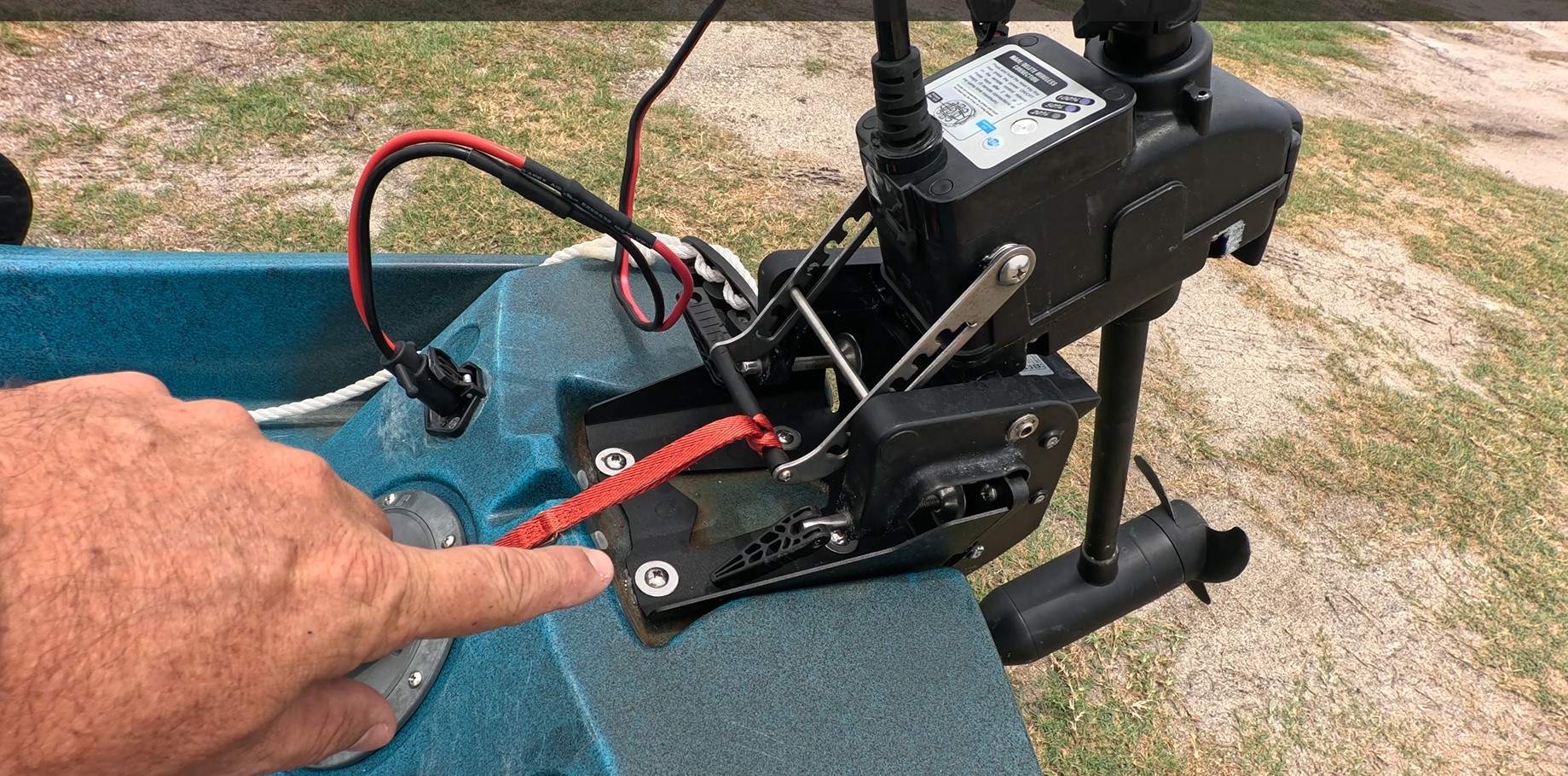
The motor handles deep water and shallow water well. The multi-position bracket allows me to trim the motor up when I get into skinny water.
I did have to create a simple DIY way to raise and lower the motor from the seat. I used two dog leashes. A red leash is connected to the release lever, and a blue leash is connected to the top of the motor. Both run back to the seat. I pull the red leash to release the lever and use the blue leash to raise or lower the motor.
It is not fancy, but it works.
Floating sea grass can bog the motor down when it collects around the prop. The fix is simple. I raise the motor, give it a quick shake, clear the grass, and keep going.
Launching, Beaching, and Transport
I have not had issues launching, beaching, loading, or transporting the kayak with this motor setup.
When launching or beaching, I raise the motor. During transport, I remove it. The motor is easy to remove and fairly light, so it does not make the setup difficult.
That portability is one of the better parts of this motor. With the right transom mounts, I can use it on more than one kayak or canoe.
Saltwater Durability
I have had the motor for about four years, and it is starting to show areas of rust around the lower unit.
I rinse the motor thoroughly after each trip and store it inside when not in use. Even with that care, saltwater eventually shows up.
I expect I may need to replace the motor within the next 18 months. That said, four years of saltwater use from a cost-effective trolling motor is still a good value in my opinion.
What I Like and What I Do Not Like
What I Like
- Easy on/off function.
- Wireless remote makes the kayak much easier to manage while fishing.
- Reliable after years of use.
- Strong enough for a fully loaded fishing kayak.
- Quiet above the water.
- Can be moved between kayaks and canoes with the right mounts.
- 12V setup keeps the system simple with one battery.
What I Do Not Like
- No reverse.
- Occasional quirky steering response from the remote.
- I wish the battery setup gave me 6 to 8 hours of runtime.
- Saltwater corrosion is starting to show after four years.
- The remote lanyard could be longer.
My Field Ratings
These ratings are based on four years of use on a Wilderness Systems Recon 120 and Old Town canoe in real Gulf Coast conditions.
Who This Motor Is For
I highly recommend the Haswing Cayman T 55 lb transom mount motor for kayak and canoe fishing.
It makes sense for anglers who want quiet 12V power, remote control, simple installation, and the ability to cover more water without spending high-end trolling motor money.
It is especially useful on a larger fishing kayak like the Wilderness Systems Recon 120, where the weight of the kayak, battery, motor, and gear makes paddling more work.
Who Should Not Buy It
I am not sure how well this motor would work on a larger boat. It is a 55 lb thrust, 12V motor. I have considered mounting it on my 18 ft pontoon, but I still need to set up wiring and a receptacle before testing that.
I do not yet know how it would handle a 1,450 lb pontoon with people, gear, and fuel. That is a review for another day.
For now, I would consider this a strong option for kayaks, canoes, inflatables, small jon boats, and other lightweight craft.
Final Verdict
The Haswing Cayman T 55 lb transom mount trolling motor has been a dependable, practical, and cost-effective upgrade for my kayak fishing setup.
It gives me enough power to cover water, fight wind and current, slow troll, sight fish, and get back to the launch with less effort. The remote control makes the kayak much easier to manage while fishing, and the 12V setup keeps the system simple.
I wish it had reverse. I wish the remote steering was perfectly proportional every time. I wish my battery setup gave me a full 6 to 8 hours.
But after four years, the motor is still working, still useful, and still giving me real value on the water.
Overall Rating: 9/10
Would I buy it again? Yes. For kayak and canoe fishing, absolutely.
Disclosure: Paddlefire Outdoors may earn a commission from links in this review, at no extra cost to you. We only recommend gear we have actually used or are actively testing in the field. This review reflects practical field experience in Florida Gulf Coast saltwater conditions.