$45 vs. $360 vs. $999 Daiwa Spinning Reels: What Are You Actually Paying For?
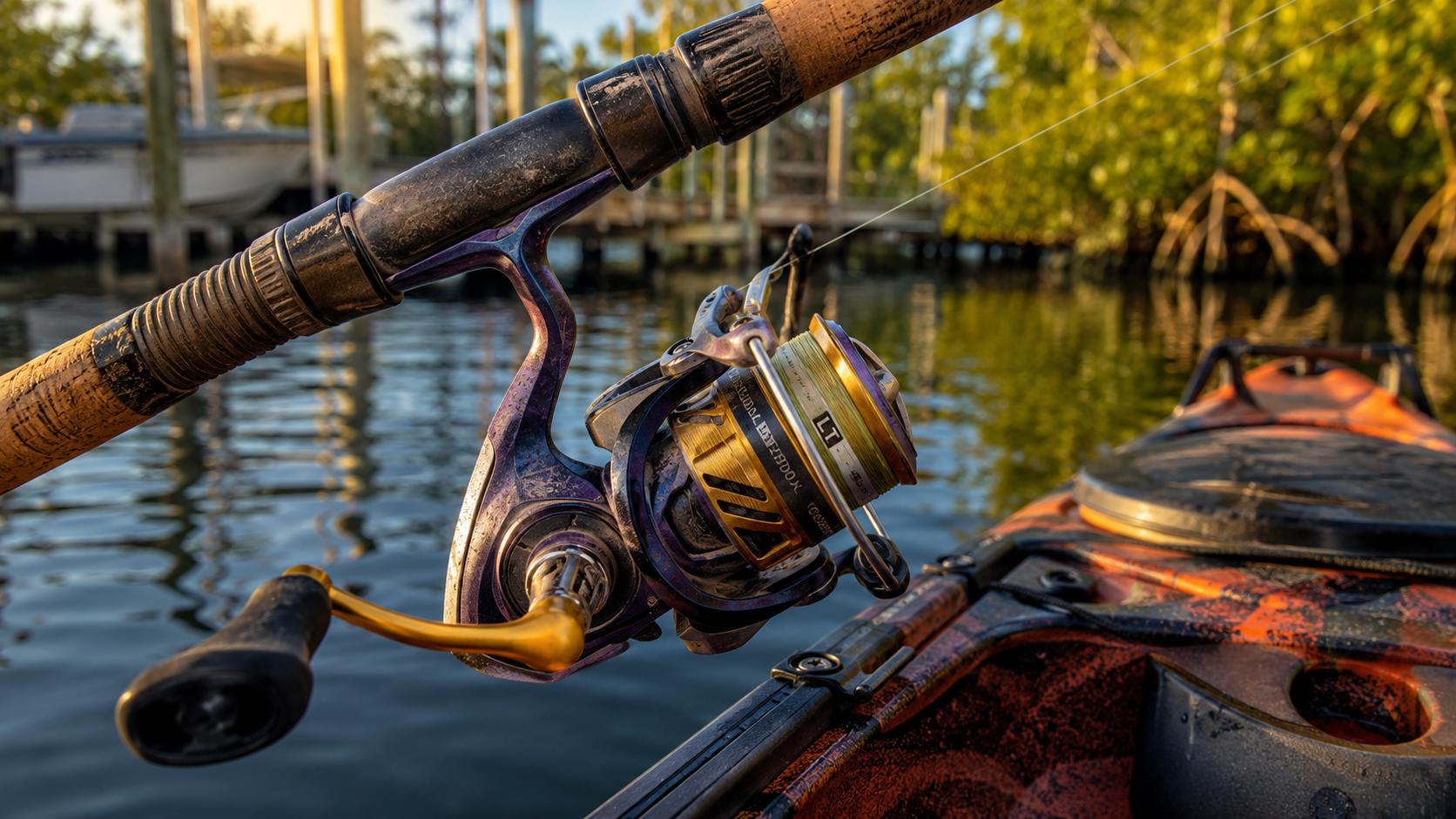
I have used two inexpensive Daiwa Laguna LT 2500 spinning reels for about four years of Florida inshore saltwater fishing. They have performed so well that the real question is not whether Daiwa's premium reels are more advanced. They are. The question is whether their additional engineering creates enough practical value to justify paying eight to twenty-two times more.
Quick Take
The expensive Daiwa is the more advanced reel. The inexpensive Daiwa may still be the better value.
The Saltist MQ and Exist offer better saltwater protection, more rigid construction, more advanced materials, additional bearing support, and—in the case of the Exist—a major reduction in weight. Those are real improvements.
But my approximately $45 Laguna LT 2500 reels have already delivered four years of excellent inshore performance. One reel even returned to normal operation after an accidental saltwater dunk, disassembly, and lubrication. For a Thrift Adventurer, a product that performs the job reliably at a fraction of the cost deserves to be judged on results rather than price.
Check the Daiwa Laguna LT 2500
The Amazon listing below is for the Daiwa Laguna LT spinning reel discussed in this review. Confirm the 2500 size, seller, and current price before ordering because availability and listing options can change.
Check Current Price on AmazonAs an Amazon Associate, Paddlefire Outdoors earns from qualifying purchases. There is no additional cost to you.
How I Ended Up at Walmart
About four years ago, I belonged to a member boat club and decided I wanted to give fishing a serious try. I had fished before, but I had not treated it as a regular hobby and did not know whether I would stay with it.
The issue was simple: I needed enough equipment to fish properly, but I did not want to spend premium money on a hobby I might abandon six months later.
So, Walmart—here I came.
I purchased two Daiwa Laguna LT 2500 spinning reels and two Ugly Stik inshore rods. I probably spent about $220 for two complete fishing setups. That was not a bad entry price for a Thrift Adventurer who wanted capable equipment without making a major commitment.
Four Years of Inshore Saltwater Use
I have used those Daiwa reels for about four years of inshore saltwater fishing. They have caught fish from boats and kayaks and have handled the normal mix of casting, retrieving, drag use, spray, wet hands, and general field use that comes with fishing Florida's Gulf Coast.
I have had no ordinary mechanical problems with either reel. They cast well, retrieve smoothly, and have given me no performance-based reason to replace them.
I currently use one of the Laguna reels on a PENN Prevail III 7-foot medium-light extra-fast inshore spinning rod. That combination works extremely well for the way I fish. The rod is light and balanced, and the reel has remained smooth and dependable. Together, they make a comfortable setup for a long day of repeated casting.
Fall and Winter Setup
15 lb braid with a 15–20 lb leader.
Spring and Summer Setup
20 lb braid with a 20 lb leader.
The One Failure: I Dunked It
The only real problem occurred while kayak fishing. I accidentally dunked one of the reels in saltwater.
After the dunk, the reel started to lock up. That is the kind of event that exposes the difference between an affordable general-purpose reel and a reel designed with more serious saltwater barriers.
I pulled the Laguna apart, lubricated it, reassembled it, and put it back into service. It now works like new.
That does not mean saltwater submersion is harmless. Daiwa's own maintenance guidance says total immersion—especially in saltwater—is bad news and recommends that a submerged reel be stripped and rebuilt as soon as possible. What my experience shows is that this particular $45 reel was recoverable and did not become disposable after one accident.
The Three-Reel Comparison
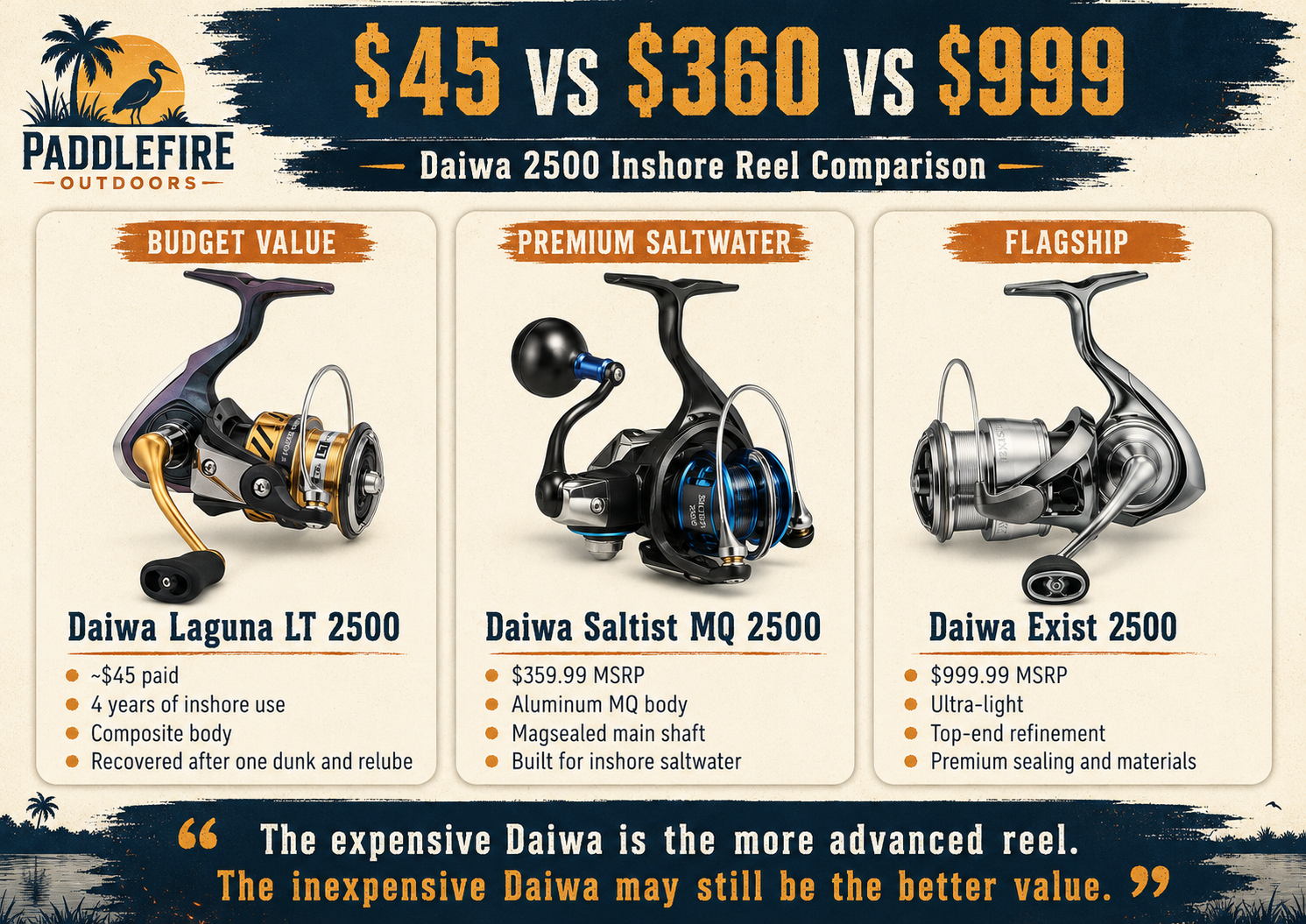
The Laguna LT, Saltist MQ, and Exist are not mechanically equal reels. The premium models contain real engineering improvements. The better comparison is whether those improvements solve a problem the angler actually has.
| Comparison Point | Daiwa Laguna LT 2500 | Daiwa Saltist MQ 2500D-H | Daiwa Exist 2500 Family |
|---|---|---|---|
| Price | About $45 paid four years ago; current Laguna line starts at $54.99 MSRP | $359.99 MSRP | $999.99 MSRP |
| My Testing | Approximately four years of actual inshore saltwater use | Specification comparison only | Specification comparison only |
| Basic Construction | Light-and-tough composite / True Carbon frame design | Heavy-duty aluminum Monocoque body | Flagship lightweight construction and premium materials |
| Bearings | 3 ball bearings plus 1 roller bearing | 6 ball bearings plus 1 roller bearing | 10 corrosion-resistant ball bearings, 2 Magsealed ball bearings, and 1 roller bearing |
| Saltwater Protection | No advertised Magsealed main-shaft barrier | Magsealed main shaft and more weather-resistant MQ housing | Premium sealing, Magsealed bearings, and corrosion-resistant bearing package |
| Weight | Earlier and current Laguna generations vary; still practical on a medium-light inshore rod | 8.8 oz | Approximately 5.6–6.2 oz in the 2500 variants |
| Maximum Drag | Varies by Laguna generation; more than adequate for my normal inshore use | 22 lb | 11 or 22 lb depending on the 2500 model |
| Best Argument | Proven performance at extremely low ownership cost | Purpose-built saltwater protection and rigid gear support | Minimum weight, maximum refinement, and flagship-level engineering |
Specifications and MSRP figures were checked against Daiwa's current U.S. product listings in July 2026. My Laguna is an earlier generation purchased about four years ago, so some current Laguna specifications may differ from the exact reel I own.
What the Saltist MQ Actually Adds
The Saltist MQ 2500D-H is the fairest premium comparison because Daiwa specifically describes the compact 2500 size as suitable for inshore fishing.
Its additional cost buys a heavy-duty aluminum frame, a Monocoque body, room for a larger drive gear, a more weather-resistant housing, Tough Digigear, additional bearings, and a Magsealed main shaft.
In practical terms, that should provide better gear alignment under load, better resistance to routine saltwater intrusion, and better long-term performance for an angler who fishes frequently and works fish around docks, mangroves, bridges, current, and other structure.
This is not cosmetic improvement. The Saltist is the more purpose-built saltwater tool.
What the $999 Exist Adds
The Exist is Daiwa's flagship spinning reel. In the 2500-size family, it can weigh as little as about 5.6 ounces, depending on the model. That is a meaningful reduction for an angler making hundreds of casts in a day.
It also adds a much more sophisticated bearing package, including corrosion-resistant and Magsealed bearings, along with premium materials, tighter refinement, and lower rotational effort.
The Exist should feel lighter, more precise, and more refined. It may remain smooth longer under demanding use, particularly when properly maintained.
That does not mean it is twenty-two times more capable of catching an inshore fish than the Laguna. It means Daiwa has spent far more money reducing weight, controlling tolerances, protecting moving parts, and refining how the reel operates.
What More Money Does Not Automatically Buy
It Does Not Guarantee More Fish
Fish do not know what the reel cost. Casting accuracy, presentation, location, line choice, leader choice, lure selection, and time on the water remain more important than the logo on the reel.
It Does Not Make a Reel Waterproof
Better sealing reduces risk during normal exposure. It does not turn a spinning reel into a sealed underwater tool.
It Does Not Remove Maintenance
Saltwater still needs to be removed, reels still need to be dried, and a submerged reel still needs immediate attention.
It Does Not Guarantee Better Value
Value depends on how much of the added engineering the owner actually uses. A guide fishing five days per week has a different equation than a weekend angler.
The Cost-Per-Year Argument
My original cost was approximately $45 per reel. After four years, that works out to $11.25 per year. If the reel reaches five years—and it appears likely that it will—the annual cost drops to $9. At six years, it falls to $7.50 per year.
The Exist is not literally one hundred times the purchase price of the Laguna. At my original $45 price, it is about twenty-two times more expensive. That is still a substantial difference. One Exist also costs about four and a half times what I paid for two complete rod-and-reel setups.
There Is Also a Repairability Tradeoff
When my Laguna locked up, I was willing to open it, lubricate it, and accept the risk. The reel cost about $45, and the repair was successful.
Daiwa advises that Magsealed components be serviced by an authorized service center. That makes sense because the magnetic-oil sealing system is specialized. It also means the premium reel may be less attractive to an owner who prefers simple do-it-yourself maintenance.
The better seal may reduce how often internal repair is needed, but when specialized service is required, the owner is dealing with a far more expensive piece of equipment.
Which Daiwa Makes Sense for You?
Choose the Laguna LT If...
- You are starting inshore fishing.
- You want multiple setups without spending heavily.
- You fish occasionally or on weekends.
- You accept that submersion is a serious risk.
- You judge gear by performance and ownership cost.
Choose the Saltist MQ If...
- You fish saltwater frequently.
- You want a rigid aluminum body and larger gear system.
- You regularly fight fish around structure and current.
- You want better protection from routine spray and exposure.
- You are willing to pay for durability-oriented construction.
Choose the Exist If...
- Low weight is a major priority.
- You cast all day and notice small balance differences.
- You value flagship refinement and premium materials.
- The $999 price will not limit the rest of your fishing budget.
- You understand that the purchase is about refinement, not guaranteed fish.
Final Verdict
The expensive Daiwa is the more advanced reel. The inexpensive Daiwa may still be the better value.
The Saltist MQ and Exist have genuine advantages. The Saltist is the better-built saltwater reel. The Exist is substantially lighter and more refined. I would not argue that my Laguna is their mechanical equal.
What I can say is that the Laguna LT 2500 has performed excellently through about four years of real inshore saltwater fishing. It casts well, retrieves smoothly, balances well on my PENN Prevail III medium-light rod, and has handled the line and leader combinations I use throughout the year.
Its one failure followed full saltwater submersion. I pulled it apart, lubricated it, and returned it to service. It works like new.
For the Thrift Adventurer, the practical question is not whether a $999 reel is better. The question is whether the reel already in your hand is preventing you from fishing effectively. Mine is not.
Until the Laguna gives me a real reason to replace it, I would rather keep using a proven reel and put the remaining money toward rods, line, lures, kayak equipment, fuel, and more days on the water.
Frequently Asked Questions
Can the Daiwa Laguna LT 2500 be used for inshore saltwater fishing?
It is not positioned as Daiwa's dedicated premium saltwater reel, but I have used two Laguna LT 2500 reels for about four years of inshore saltwater fishing with excellent results. Avoid submersion, remove salt after use, and understand that its protection is not equivalent to a Magsealed saltwater model.
Is the Daiwa Saltist MQ waterproof?
No. Its Magsealed main shaft is designed to reduce water and dust penetration during normal use, but Daiwa specifically states that Magsealed reels are not waterproof.
Is a $999 Daiwa Exist worth it for inshore fishing?
It can be worth it for an angler who places a high value on low weight, smooth rotation, premium materials, corrosion-resistant bearings, and flagship refinement. It is harder to justify for a budget-conscious weekend angler whose inexpensive reel is already performing reliably.
What line do I use on the Daiwa Laguna LT 2500?
I typically use 15 lb braid with a 15–20 lb leader during fall and winter. During spring and summer, I usually use 20 lb braid with a 20 lb leader.
What should I do if a spinning reel is dunked in saltwater?
Act immediately. Daiwa recommends rinsing the reel with freshwater, shaking out excess water, and having it stripped and rebuilt as soon as possible because saltwater can begin damaging internal components within days.
Manufacturer Sources
Premium-reel construction, pricing, and maintenance statements in this comparison were checked against Daiwa's current U.S. product and maintenance pages. Prices can change.
Disclosure: The Daiwa Laguna LT 2500 discussed in this review is based on approximately four years of my actual Florida Gulf Coast inshore use. I have not field-tested the Saltist MQ 2500 or Exist 2500 for this article; those reels are included as manufacturer-specification and value comparisons. As an Amazon Associate, Paddlefire Outdoors earns from qualifying purchases, at no additional cost to the reader. Prices, availability, sellers, and specifications were reviewed in July 2026 and may change.